
Where ancient Ayurveda meets modern science.
Ayurveda is a holistic system of health that originated in India over 5,000 years ago — from the Sanskrit Ayur (life) and Veda (science), the "Science of Life." It emphasizes the balance of body, mind and spirit to promote health and lasting well-being.
A holistic framework, refined over five millennia.
Far older than most recorded systems of medicine, Ayurveda is not a collection of recipes but a complete philosophy of living. It regards the human being as an indivisible whole — physiology, psychology and consciousness interwoven — and seeks equilibrium above all else.
At GreenSpace Herbs, this ancient framework is the conceptual foundation beneath our modern platform. We read its principles through the lens of analytical chemistry, pharmacokinetics and quantum modelling — preserving the wisdom while grounding every claim in evidence.
The three doshas — the body's biological energies.
The five elements combine in the human body to form three doshas. Each person carries a unique combination of these doshas, known as their Prakriti — their innate bodily constitution.
Governs movement and communication — the principle of motion throughout the body and mind.
Governs digestion and transformation — the metabolic fire that converts and processes.
Governs structure and stability — the cohesive principle that builds and protects tissue.
The five elements that compose the universe.
Ayurveda is built on the idea that the entire universe — and the human body within it — is composed of five fundamental elements.
Earth · Prithvi
The solid state — structure, density and the material substance of the body.
Fire · Agni
Transformation and heat — the engine of digestion, metabolism and perception.
Air · Vayu
Movement and impulse — the force behind circulation, respiration and the nervous system.
Water · Jal
Cohesion and fluidity — the medium of nourishment, lubrication and flow.
Space · Akasha
The subtle ether — the field of openness within which all the other elements exist.
Health as a state of dynamic balance.
According to Acharya Sushruta, a person is healthy when there is balance among the doshas, proper digestion (Agni), well-nourished tissues (Dhatus) and efficient elimination of waste (Malas). True health also includes clarity of the soul (Atma), the senses (Indriyas) and the mind (Mana).
"Rogastu Dosha Vaishamyam, Dosha Samyam Arogata" — imbalance arises when the doshas are out of proportion; health is restored when they are balanced.
— Acharya Charaka
Well-being is balance — and balance is a daily practice.
Ayurveda understands well-being as balance among the body's systems, and places its strongest emphasis on maintaining that balance. Wellness is cultivated daily.
Dinacharya
Daily routines that align the body's rhythms with the cycle of the day.
Ritucharya
Seasonal routines that adjust diet and conduct to the changing seasons.
Proper Diet
Food chosen and timed to support digestion and constitutional balance.
Lifestyle & Mind
Conduct and mental well-being regarded as inseparable from physical health.
Knowledge that descended through the sages.
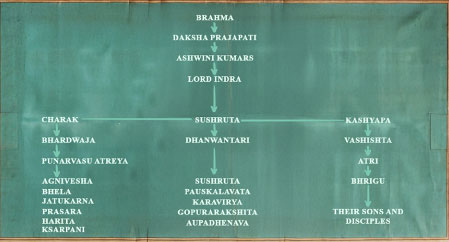
Vagbhatacharya, in the Ashtanga Hridaya, states that Lord Brahma is the creator of Ayurveda — perceiving its knowledge through divine senses, then passing it to the Ashwini Kumaras, and onward to Indra and the eligible rishis. The science then branched out to Bharadwaja, Dhanwantari and Vashishta.
Bharadwaja, circa 700 BC, is regarded as the father of Ayurveda for the human race. From him the knowledge spread to the sages, and — too vast for any single person to absorb — was organized into eight specialized branches.
Perceived the knowledge of Ayurveda through divine senses.
Received and carried the knowledge forward.
The lineage passed onward to the celestial teachers.
Father of Ayurveda for the human race; structured it for mankind.
Spread to all eligible sages and satvik practitioners.
One science, eight interconnected disciplines.
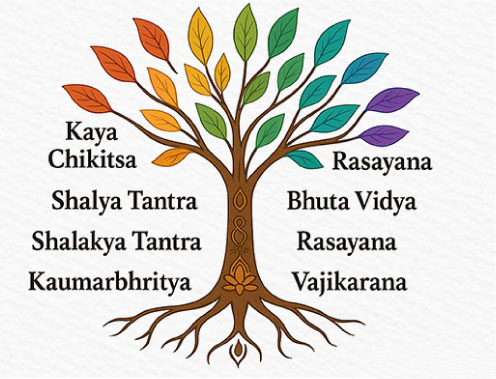
Because Ayurveda was too extensive for a single person to absorb, Sage Bharadwaja organized it into eight specialized branches — each a distinct discipline, yet interconnected as parts of one living system of health.
Among these are the rejuvenative and longevity sciences that resonate most with our work today:
- Rasayana — the science of rejuvenation: practices that support vitality and healthy ageing.
- Vajikarana — the science of reproduction, procreation and vital strength.
These branches do not stand alone. They share a common diagnostic language of doshas, tissues and balance, allowing knowledge from one to inform the others.
A 5,000-year science, re-read through quantum eyes.
See how GreenSpace Herbs translates the principles of Ayurveda into clinically studied, energized active ingredients.
Where holistic philosophy meets quantum inquiry.
Ayurveda and quantum science operate in very different domains — one is ancient and holistic, the other modern and mathematical. There is genuine beauty in exploring how traditional knowledge can inspire modern inquiry, but it must be grounded in evidence and critical thinking, with a clear line drawn between metaphor, philosophy and verified science.
The convergence of the two offers a compelling framework for understanding health, consciousness and well-being — bridging ancient wisdom with modern method to illuminate the energetic and informational aspects of human physiology. Recent studies suggest Ayurvedic concepts align with principles of quantum cognition, an emerging field that applies quantum theory to cognitive processes: the Ayurvedic principle of Prabhava (effect) parallels the non-intuitive effects observed in quantum phenomena, while Ojas (vital energy) resembles the energy states of quantum systems.
Two languages, one underlying intuition.
Where the texts of Ayurveda and the equations of quantum physics describe a strikingly similar picture of an interconnected, consciousness-aware reality.
Ayurveda
- Body–mind–spiritOne interconnected system
- PurushaConsciousness is primary
- PranaUniversal life energy
- Chakras & NadiSubtle energy flows
Quantum Science
- ✓ Non-localityParticles are connected
- ✓ Wave collapseObserver may play a role
- ✓ Quantum fieldsEnergy underlies matter
- ✓ Field dynamicsEnergy in motion
This theory suggests that Ayurveda, like quantum physics, was pre-existing — a body of knowledge perceived beyond ordinary human perception, then memorized and transmitted. Both traditions point toward a reality in which matter, energy and awareness are inseparable.
Designing formulations that work at the quantum level.
Customized herbal formulations designed to support balance by enhancing cellular energy and coherence — modelled with the tools of modern computational chemistry.
Quantum chemistry models the molecular behaviour of Ayurvedic compounds — using NMR and related methods to predict how they act.
Predicting the synergistic effects of multi-component herbal formulations before they reach the bench.
Ayurvedic Bhasmas — nano-preparations of metals and minerals — studied for their quantum behaviour.
Quantum dots leveraged for energy-sensitive delivery, inspired by Ayurvedic targeting such as marma points.
From philosophy to a research programme.
Used responsibly, this interdisciplinary approach supports everyday wellness and healthy ageing — but only when metaphor is held apart from verified science, and every step is tested.
Building the bridge in practice means assembling new kinds of teams and tools:
- Interdisciplinary centres bringing together physicists, Ayurvedic physicians, pharmacologists and AI researchers.
- Quantum-biophoton measurement tools developed to test Ayurvedic drugs.
- Clinical trials that combine Ayurvedic regimens with quantum-modelled formulations.
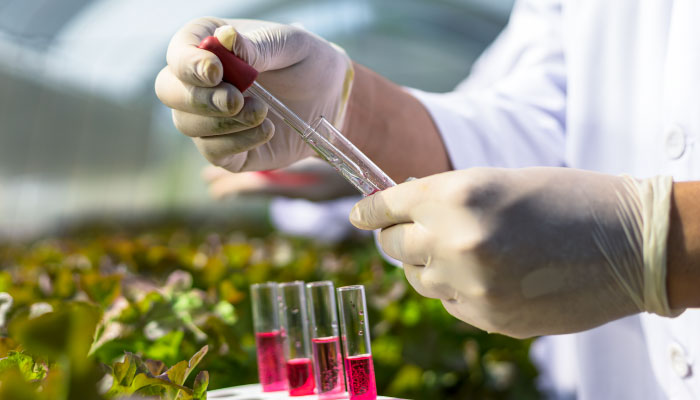
An honest map of the road ahead.
Bridging a qualitative, experience-based tradition with a quantitative science demands rigour, humility and new methodology.
None of these challenges is a dead end. Each defines a concrete research agenda — better-controlled clinical studies, standardized botanical inputs, validated measurement, and a disciplined separation of philosophy from proof. This is precisely the territory GreenSpace Herbs operates in: taking what Ayurveda intuited and subjecting it to the full weight of modern analytical science.
Ancient principles, validated by modern method.
Discover how GreenSpace Herbs turns the Science of Life into clinically studied, energized active ingredients.