

Cassia angustifolia, commonly known as Indian Senna, Tinnevelly Senna, or Senna Maki, is a small shrub belonging to the family Fabaceae. Preparations from its leaves and pods are widely recognized for their laxative, digestive, anti-inflammatory, and detoxifying properties.
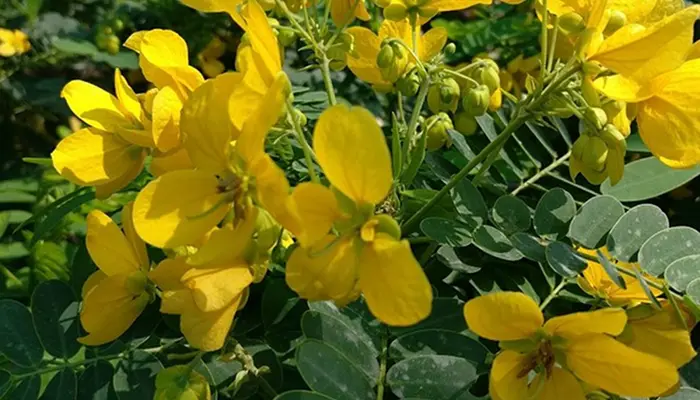
Cassia's laxative effect is driven by glycosides — specifically Sennosides A, B, C, and D — which stimulate bowel movement and intestinal motility, making the plant highly effective in relieving constipation (Najeeb et al., 2025). Sennosides are naturally occurring dianthrone glycosides, composed of two linked anthraquinone units attached to sugar moieties.
The Chemistry That Powers Senna
Not all sennosides contribute equally. The family of glycosides is dominated by two principal agents, with two further variants present at lower concentrations:
- Sennoside A & B — the principal agents responsible for cathartic activity.
- Sennoside C & D — present in smaller amounts; they contribute to the overall pharmacological effect.
Note: Sennoside concentration varies with plant maturity, environmental conditions, and processing methods. Younger leaves and pods tend to have higher content, and proper drying is essential for stability (Franz, 1993).
How Sennosides Work: A Prodrug Mechanism
Less than 10% of sennosides are absorbed from the gut. They are not directly active in their original form — instead, they function as a prodrug.
Sennosides pass through the upper gastrointestinal tract unabsorbed and are converted by intestinal bacteria in the colon into rhein anthrone. This active metabolite acts on the colonic muscles, enhancing peristaltic movement, accelerating intestinal transit time, and promoting efficient bowel evacuation (Le et al., 2021). The prodrug design ensures action is limited to the large intestine, minimizing systemic exposure.
Rhein anthrone also acts on the colonic mucosa, stimulating macrophages to release prostaglandin E2 (PGE2). This triggers a cascade that:
- Downregulates aquaporin (AQP3), reducing water reabsorption from the colon into the bloodstream.
- Promotes electrolyte secretion into the lumen, creating an osmotic gradient that draws water into the bowel.
- Results in softer, bulkier stool and faster colonic transit (Kon et al., 2014).
What makes Senna effective is this dual mechanism — increased motility combined with enhanced water secretion.
Safety Considerations
Though uncommon, severe reactions such as anaphylaxis have been reported with Cassia-containing herbal products (Beltrá-Picó et al., 2024; Irazábal et al., 2021). Clinicians and formulators should account for potential drug–herb interactions in sensitive populations.
Clinical and Formulation Relevance
Cassia angustifolia's well-defined laxative action keeps it pharmacologically relevant in modern medicine. Beyond constipation relief, growing research is exploring its role in metabolic regulation, inflammation control, and other disease pathways — making it a compelling ingredient for next-generation nutraceutical formulations.
Bibliography
- Beltrá-Picó, I., et al. (2024). Cassia angustifolia and tacrolimus interaction in a liver transplant patient, a case report. British Journal of Clinical Pharmacology, 90(7), 1745–1750. https://doi.org/10.1111/bcp.16079
- Franz, G. (1993). The Senna Drug and Its Chemistry. Pharmacology, 47(1), 2–6. https://doi.org/10.1159/000139654
- Irazábal, B., et al. (2021). Anaphylaxis Due to Senna (Cassia angustifolia). Journal of Investigational Allergology and Clinical Immunology, 31(1), 71–73. https://doi.org/10.18176/jiaci.0608
- Kon, R., et al. (2014). Rheinanthrone, a metabolite of sennoside A, triggers macrophage activation to decrease aquaporin-3 expression in the colon. Journal of Ethnopharmacology, 152(1), 190–200. https://doi.org/10.1016/j.jep.2013.12.055
- Le, J., et al. (2021). Pharmacology, Toxicology, and Metabolism of Sennoside A. Frontiers in Pharmacology, 12. https://doi.org/10.3389/fphar.2021.714586
- Najeeb, et al. (2025). Cassia angustifolia (Senna): phytochemistry and laxative pharmacology.