

Gymnema sylvestre, commonly known as the "sugar destroyer," has been widely used in traditional medicine for managing diabetes and metabolic disorders. Modern research identifies gymnemic acids — oleanane-type triterpenoid saponins — as the primary bioactive compounds responsible for its metabolic benefits. Emerging evidence highlights multiple mechanisms through which gymnemic acids support blood glucose control and broader metabolic health.
Introduction
For centuries, Gymnema sylvestre has held a place in Ayurvedic and folk medicine as a botanical ally against high blood sugar. Today, researchers are working to understand the molecular basis for these traditional uses. At the centre of this story sit the gymnemic acids — a family of saponins whose distinctive chemistry allows them to act at several points along the glucose pathway, from the taste buds on the tongue to the metabolic machinery inside cells.
What Are Gymnemic Acids? (Structure & Functional Properties)
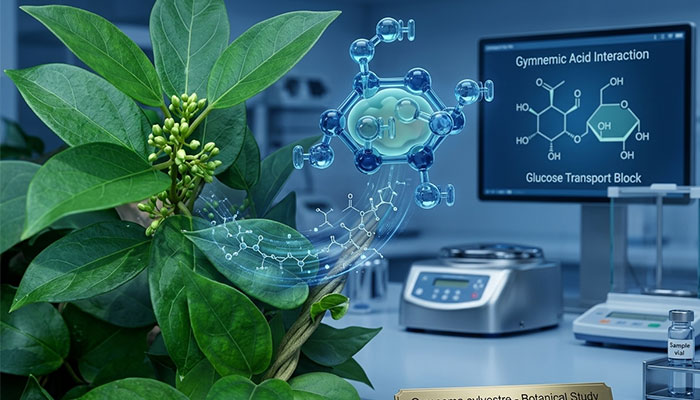
Gymnemic acids consist of a hydrophobic triterpenoid backbone (gymnemagenin) linked to hydrophilic sugar moieties, giving them amphiphilic properties. This unique structure enables them to interact with both lipid-rich and water-soluble environments — including the membranes of taste receptors and the lining of the intestine.
Over 20 different gymnemic acid analogs have been identified, contributing to their broad pharmacological activity. However, structure–activity relationships (SAR) remain under investigation, and the precise contribution of each analog to the herb's overall effect is still being mapped.
1. How Gymnemic Acids Reduce Sugar Cravings
Human Evidence
One of the most well-documented effects of gymnemic acids is their ability to block sweet taste perception. Studies show that consumption of Gymnema extracts can temporarily suppress sweetness for 30–60 minutes, leading to:
- Reduced perceived sweetness of foods and beverages
- Diminished appetite for sugary foods
- Lower overall sugar intake during the suppression window
This behavioral mechanism plays a key role in metabolic health management, helping curb the cravings that often drive excess calorie and carbohydrate consumption.
Mechanism of Action
Gymnemic acids interact with the T1R2/T1R3 sweet taste receptor, inhibiting its activation and reducing sweet taste signaling. However, the exact binding mechanism is still being studied, and the suppression is reversible as the compounds clear from the receptor.
2. Inhibition of Intestinal Glucose Absorption
Clinical Insights
Human studies indicate improvements in post-meal glucose handling and fasting blood sugar markers with Gymnema supplementation. However, direct confirmation of intestinal glucose inhibition in humans is limited, and much of the mechanistic detail comes from laboratory models.
Mechanism
Preclinical studies suggest gymnemic acids may inhibit the transporters and enzymes responsible for moving and breaking down sugars in the gut. This reduces glucose uptake in the intestines, potentially lowering blood sugar spikes after meals.
3. Effects on Insulin Secretion & Pancreatic Function
Preclinical Evidence
Animal studies demonstrate that gymnemic acids may stimulate insulin secretion and support the health of insulin-producing pancreatic β-cells. Some models even point toward enhanced β-cell activity following supplementation.
That said, claims of β-cell regeneration remain preclinical and not yet clinically proven in humans. These findings are promising but should be interpreted with appropriate caution.
4. Impact on Key Metabolic Pathways
Gymnemic acids may influence major intracellular signaling pathways involved in energy balance and glucose handling. Activation of these pathways is associated with:
- Improved glucose uptake into cells
- Better regulation of blood sugar levels
- More efficient energy metabolism
Most evidence here comes from animal and in vitro studies, with limited direct human validation to date.
5. Additional Benefits for Metabolic Health
Lipid Metabolism
Preliminary clinical findings suggest improvements in lipid profiles — including measures such as total cholesterol and triglycerides — that are relevant to overall cardiometabolic health.
Antioxidant & Anti-inflammatory Effects
Gymnema extracts exhibit antioxidant and anti-inflammatory activity in experimental models. These effects support the management of metabolic syndrome and insulin resistance, where oxidative stress and chronic low-grade inflammation play important roles.
6. Standardization & Quality Considerations
The effectiveness of gymnemic acids depends heavily on extract quality and standardization. Most commercial extracts are standardized for gymnemic acid content using validated analytical methods to ensure a consistent, potent dose.
Proper formulation and dosing are critical for consistent clinical outcomes — variability in raw material and processing can meaningfully change how an extract performs.
Conclusion
Gymnemic acids are promising natural compounds with multi-targeted effects on glucose metabolism and metabolic health. Their key mechanisms include:
- Suppression of sweet taste perception and reduced sugar cravings
- Inhibition of intestinal glucose absorption
- Support for insulin secretion and pancreatic health
- Modulation of key metabolic signaling pathways
While supported by strong preclinical evidence and emerging clinical data, large-scale human studies are still needed to fully validate their therapeutic potential. Gymnemic acids represent a scientifically backed yet evolving solution for managing diabetes, insulin resistance, and metabolic disorders.