

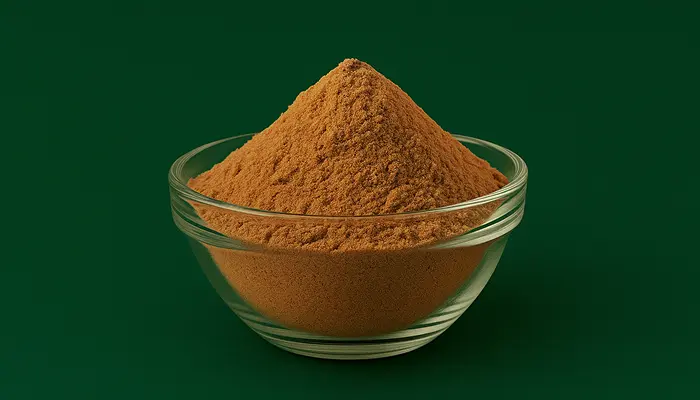
Shatavari (Asparagus racemosus Willd.)
A much-branched, spinous undershrub whose fusiform, succulent tuberous roots have long been prized in Ayurveda as a cooling, restorative tonic — standardized today as a triterpene-saponin-rich botanical extract.
What is Shatavari?
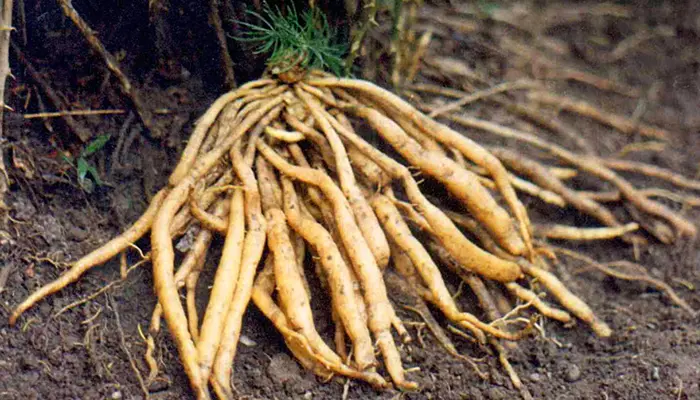
Asparagus racemosus Willd., known across the Ayurvedic tradition as Shatavari, is a much-branched, spinous undershrub of the family Liliaceae. Its defining feature is a cluster of fusiform, succulent, tuberous roots — the part of the plant that is collected, dried and processed into extract. These roots carry the botanical's characteristic activity and are described in classical materia medica as emollient, cooling and aphrodisiac.
Chemical constituents
The chief chemical constituents of Shatavari are the triterpene saponins Shatavarin I and Shatavarin IV. These steroidal saponins, concentrated in the tuberous roots, are regarded as the marker actives of the botanical and form the basis on which a quality Shatavari extract is profiled and standardized.
Parts used
The tuberous roots are the part used. Their succulent, fusiform tubers are the reservoir of the plant's saponin content and are the material from which the standardized botanical extract is prepared.
Traditional & Ayurvedic properties
In Ayurvedic usage the roots are valued as emollient, cooling and aphrodisiac. They are traditionally indicated across a broad range of conditions, including:
- Nervous disorders and general debility
- Dyspepsia and disorders of digestion
- Tumours
- Scalding of urine
- Throat infections
- Tuberculosis, cough and bronchitis
Shatavari is among the most widely used restorative tonics of the classical tradition — turned to wherever a cooling, nourishing and rejuvenating action is sought.
Reported activity
Beyond its classical indications, the root extracts have been reported to exhibit antiallergic activity. Clinical observation also indicates that the tuberous roots act as a galactagogue — increasing milk production in lactating women — a use for which Shatavari is particularly well known.
Uses & benefits
Traditionally indicated in nervous disorders, dyspepsia, tumours, scalding of urine, throat infections, tuberculosis, cough, bronchitis and general debility. The root extracts have additionally been reported to show antiallergic activity.
A cooling, emollient restorative tonic. Clinical observation indicates the tuberous roots act as a galactagogue, supporting milk production in lactating women — a basis for use in women's health and rejuvenative formulations.
Related botanical extracts
Source clinically researched botanicals.
Partner with GreenSpace Herbs for standardized, quality-assured extracts.