

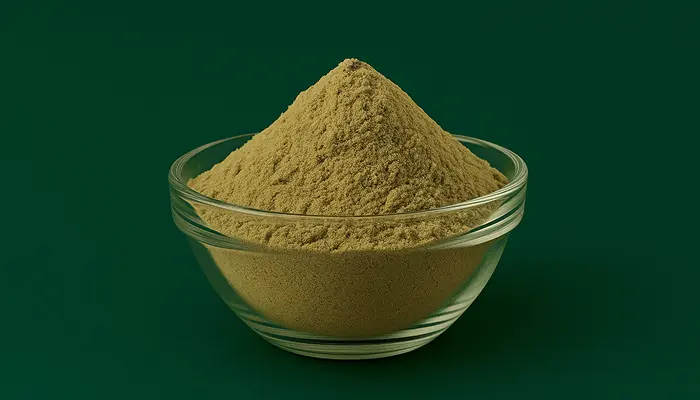
Bhringaraja (Eclipta alba)
An erect, much-branched annual herb whose leaves and aerial parts yield wedelolactone and demethylwedelolactone — long valued in Ayurveda as a hepatoprotective and anti-inflammatory tonic.
What is Bhringaraja?
Eclipta alba (Linn.) Linn., known in Ayurveda as Bhringaraja and belonging to the family Asteraceae, is an erect or prostrate, much-branched, hirsute annual herb that often roots at the nodes. Its leaves are opposite and sessile, and the plant spreads readily across damp, low-lying ground. Across traditional Indian medicine it has been employed as a tonic and deobstruent, particularly in the management of hepatic and splenic enlargements.
Botanical description
Bhringaraja is a herbaceous annual with a habit that ranges from erect to prostrate. The stems are much-branched and hirsute (covered in fine, stiff hairs), and the plant has a characteristic tendency to root at the nodes wherever they make contact with moist soil. The leaves are opposite and sessile, set directly against the stem without stalks — a feature that helps distinguish the herb in the field.
Parts used
The whole herb — principally the leaves and aerial parts — is collected and processed. These tissues concentrate the coumestan constituents that define the plant's pharmacological profile.
Principal constituents
The principal constituents of the herb are the coumestan compounds wedelolactone and demethylwedelolactone. These molecules are widely regarded as the markers responsible for much of Bhringaraja's recognised biological activity and are the natural basis for standardizing the extract.
Traditional & pharmacological activity
In traditional practice the herb is used as a tonic and deobstruent in hepatic and splenic enlargements. Beyond this classical application, the plant possesses well-documented hepatoprotective and anti-inflammatory properties, making it a botanical of continuing interest for liver-supportive and inflammation-modulating formulations.
- Hepatoprotective — supportive of liver tissue and function.
- Anti-inflammatory — modulation of the inflammatory response.
- Tonic & deobstruent — traditional use in hepatic and splenic enlargements.
Uses & benefits
Traditionally employed as a tonic and deobstruent in hepatic and splenic enlargements, with documented hepatoprotective and anti-inflammatory activity attributed to its coumestan constituents.
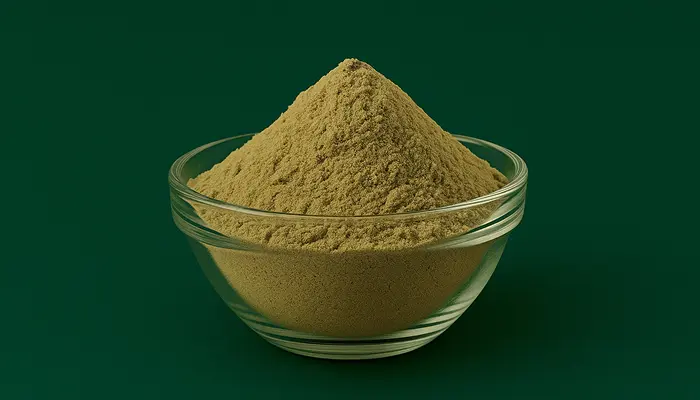
A standardized Bhringaraja extract, rich in wedelolactone, suits liver-supportive and inflammation-modulating formulations for supplements and functional products.
Related botanical extracts
Source clinically researched botanicals.
Partner with GreenSpace Herbs for standardized, quality-assured extracts.