

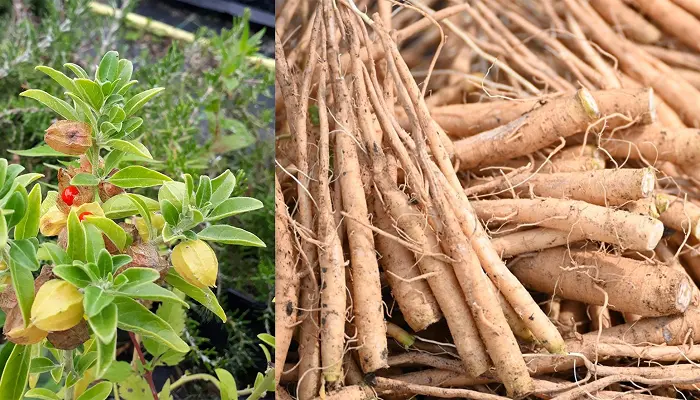
Ashwagandha (Withania somnifera)
The restorative adaptogen for stress, vitality and hormonal balance — one of Ayurveda's most powerful Rasayana rejuvenators, helping the body adapt to physical and emotional stress.
What is Ashwagandha?
Withania somnifera, commonly known as Ashwagandha, is one of the most powerful rejuvenating herbs in Ayurveda. Renowned as a Rasayana (rejuvenator), Ashwagandha enhances stress resilience, cognitive function, hormonal balance and immune strength. Its adaptogenic properties help the body adapt to physical and emotional stress, making it an essential herb for modern lifestyles.
Ashwagandha is a woody shrub with greenish-yellow flowers and small red berries, typically growing 1–1.5 meters tall. The roots are the primary part used in medicine, though the leaves and berries are also recognized for specific pharmacological actions.
Ayurvedic properties
- Rasa: Tikta (bitter), Kashaya (astringent)
- Virya: Ushna (heating)
- Vipaka: Madhura (sweet post-digestive effect)
It primarily pacifies Vata and Kapha doshas and is used in conditions of fatigue, debility, anxiety, infertility and neurodegenerative disorders.
Where does it grow?

Geographical distribution
- India — especially Madhya Pradesh, Rajasthan, Gujarat and Uttar Pradesh
- Sri Lanka
- Middle East
- North Africa
- Parts of the USA, Australia and the Mediterranean regions
Ideal growing conditions
Ashwagandha is a hardy plant grown primarily in organic herbal farms and dryland agroforestry models. It thrives in warm, dry climates, at moderate altitude, in well-drained soils with low rainfall — conditions that concentrate its valued root constituents.
Parts used and phytochemical constituents
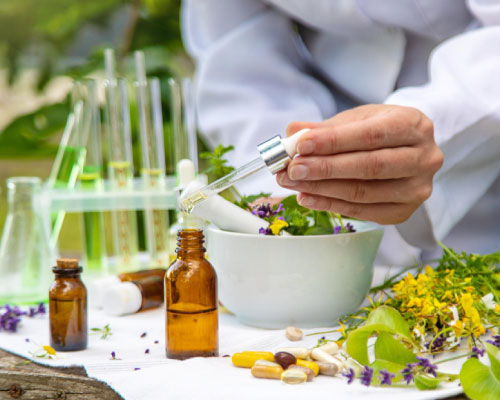
Key phytochemicals
- Withanolides (withaferin A, withanolide D): adaptogenic, anti-inflammatory
- Alkaloids (somniferine, anaferine): sedative and tonic properties
These constituents collectively deliver adaptogenic, neuroprotective, anxiolytic, immunomodulatory and anti-inflammatory actions.
Therapeutic benefits
Ashwagandha offers holistic benefits across the physical, mental, endocrine and reproductive systems. It restores equilibrium during chronic stress, fatigue, hormonal imbalance and nervous exhaustion.
Stress & nervous system
- Regulates cortisol levels and reduces symptoms of chronic stress
- Enhances emotional stability, focus and resistance to burnout
- Used in generalized anxiety disorder, depression and insomnia
Cognition & neuroprotection
- Promotes neuronal regeneration and neuroplasticity
- Used in dementia, Parkinson's, ADHD and cognitive fatigue
Hormonal & reproductive health
- Supports thyroid hormone production, especially in hypothyroidism
- Balances cortisol, testosterone and estrogen levels
- Helps reduce PCOS symptoms such as irregular periods and stress-related infertility
- Improves sperm count, motility and testosterone levels in men
- Enhances libido, ovulatory function and vitality in women
Immunity, strength & vitality
- Used in sports nutrition and Rasayana tonics for muscle development
- Modulates both innate and adaptive immune responses
- Reduces pro-inflammatory cytokines and protects against infection
- Beneficial in autoimmune disorders and post-viral fatigue
How to use Ashwagandha safely
Ashwagandha is well-tolerated and may be used daily for restorative and preventive health, or as part of a therapeutic protocol.
Common forms
- Powder (Churna): mixed with milk, honey, ghee or water
- Capsules / Tablets: standardized extracts (often 5–10% withanolides)
- Root extract: aqueous or alcohol-based
- Ashwagandha oil: used for massage in Vata disorders
- Ashwagandharishta: classical fermented tonic for weakness and anxiety
Key research highlights
Ashwagandha's effects are supported by numerous clinical and experimental studies.
- Stress and cortisol: randomized trials show reduced cortisol and improved anxiety scores
- Cognition: trials in adults show enhanced working memory and task performance
- Hypothyroidism: shown to normalize TSH, T3 and T4 in subclinical hypothyroidism
- Fertility: improves semen quality and testosterone in infertile men
- Muscle strength: increases in muscle mass and strength seen in resistance-training trials
Ashwagandha is featured in global herbal pharmacopeias and recognized in functional and integrative medicine protocols.
Precautions and contraindications
Ashwagandha is generally safe, but certain populations should use caution.
- Pregnancy: may stimulate uterine activity — avoid unless prescribed
- Hyperthyroidism: monitor thyroid levels, as it may enhance T3/T4 output
- Autoimmune conditions: consult a healthcare provider for lupus, MS or RA
- Sedative medications: may have additive CNS-depressant effects
- Mild GI upset or loose stools (typically at high doses)
- Headache or palpitations in sensitive individuals
References
- Chandrasekhar, K., Kapoor, J., Anishetty, S. (2012). A prospective, randomized double-blind study of the safety and efficacy of a high-concentration full-spectrum extract of Ashwagandha root in reducing stress and anxiety. Indian Journal of Psychological Medicine, 34(3), 255–262.
- Wankhede, S., et al. (2015). Examining the effect of Withania somnifera supplementation on muscle strength and recovery. Journal of the International Society of Sports Nutrition, 12(1), 43.
- Raut, A. A., et al. (2012). Exploratory study to evaluate tolerability, safety and activity of Ashwagandha. Journal of Ayurveda and Integrative Medicine, 3(3), 111–114.
- Auddy, B., et al. (2008). A standardized Withania somnifera extract improves stress resistance in humans. Journal of the American Nutraceutical Association, 11(1), 50–56.
- Tiwari, R., et al. (2014). Evaluation of thyroid hormone modulation by Ashwagandha root extract in subclinical hypothyroid patients. Journal of Alternative and Complementary Medicine, 20(3), 169–173.
Uses & benefits
Adaptogenic regulation of cortisol and chronic stress; anxiolytic and antidepressant support; neuroprotective action in dementia, Parkinson's and ADHD; thyroid hormone modulation in hypothyroidism; and immunomodulatory, anti-inflammatory effects in autoimmune and post-viral fatigue.
A daily restorative tonic for vitality and resilience — used in Rasayana and sports-nutrition formulations for muscle strength and recovery, hormonal and reproductive balance, improved sleep and focus, and overall stress-driven wellbeing.
Related botanical extracts
Source clinically researched botanicals.
Partner with GreenSpace Herbs for standardized, quality-assured extracts.